What should a DevOps Engineer resume include?
A DevOps engineer resume should include a short profile, a skills section grouped by cloud, containers, automation and monitoring, experience bullets that show deployment speed, uptime or cost savings, relevant certifications such as AWS or CKA, and your education. Use FixDoks to build it on one or two pages and check how ATS software reads it.
DevOps Engineer Resume at a glance
| Design | Tech, ATS-friendly |
|---|---|
| Sample | PDF and Word download |
| Examples | 14 bullet points, 24 skills |
| Processing | On our server over HTTPS; files are deleted right after conversion |
| Max file size | 50 MB per file |
| Price | Free to use, no watermark |
| Download | First download free, then ₹49 for 2 months of unlimited downloads (US$3 outside India) |
| Files at once | 1 free, up to 30 with a plan |
| Works on | Chrome, Edge, Safari and Firefox on Windows, Mac, Android and iPhone |
How to use DevOps Engineer Resume Template
- Click Use this template to open the builder with the Tech design and a DevOps Engineer section order, or Edit this example to start from the sample.
- Fill in your details. Use Examples and Skills by job for ready-made lines, or the AI writer for your own notes.
- Check the resume score, paste the job ad to see missing keywords, then download your PDF.
DevOps Engineer resume sample
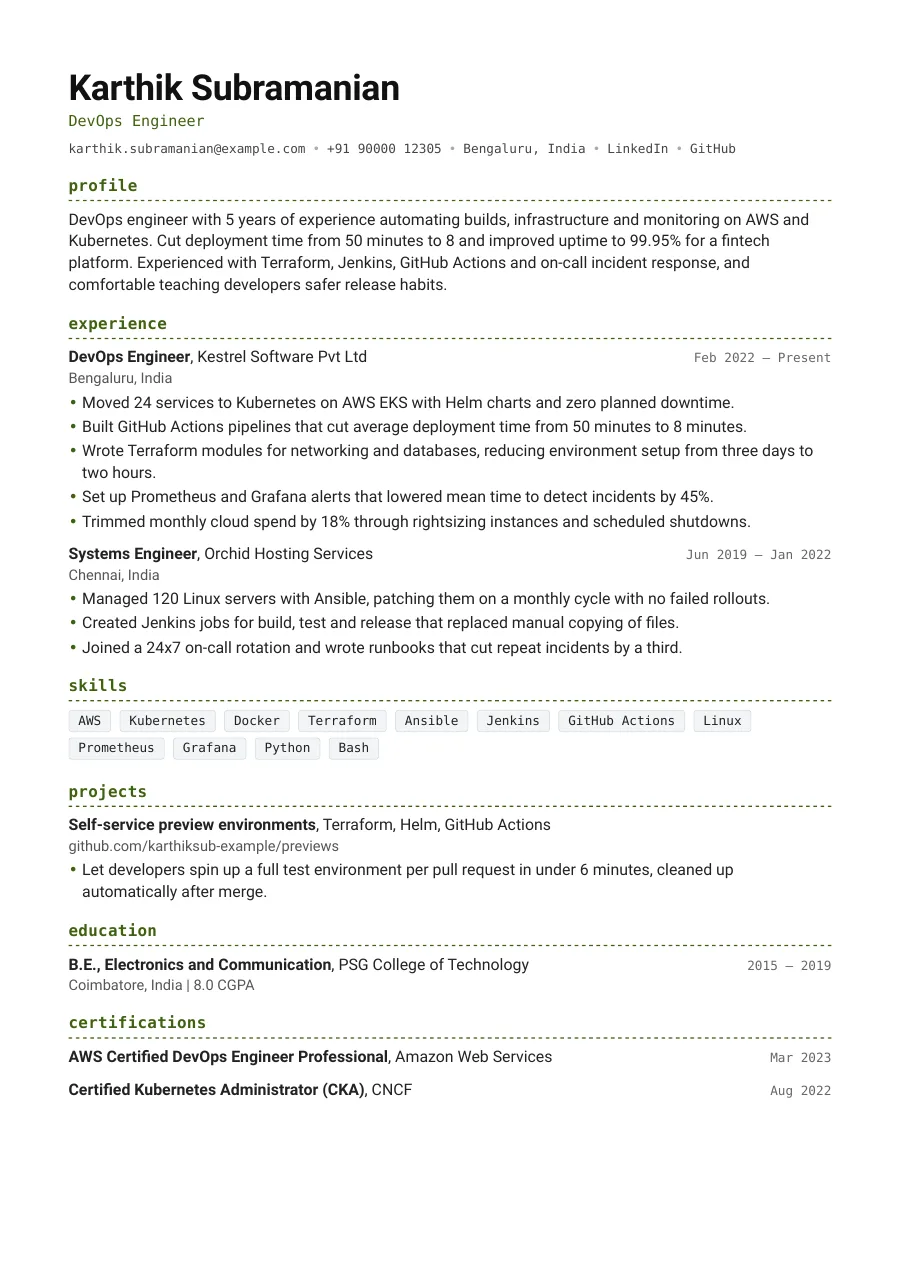
What recruiters look for in a DevOps engineer
Hiring managers read DevOps resumes looking for evidence of three outcomes: faster delivery, higher reliability and lower cost. A list of tools tells them what you touched. A bullet with a number tells them what changed. Aim for at least one measurable result under each role.
Best section order
- Contact details with GitHub and LinkedIn
- Profile of three lines
- Skills grouped by category
- Experience
- Projects, especially infrastructure code you can share
- Certifications and education
For this role, certifications are worth a visible position because many companies filter on them. If you hold two or three strong ones, place them directly after skills.
How to write the summary
State your years of experience, your cloud platform, the scale you work at and one headline result. For example: five years automating AWS and Kubernetes, cut deployment time from 50 minutes to 8. Avoid vague claims about being a team player. The summary generator can produce options to edit.
Bullets that show impact
| Weak | Strong |
|---|---|
| Managed CI/CD pipelines | Rebuilt GitHub Actions pipelines with parallel tests, cutting deploys from 50 to 8 minutes |
| Worked on Kubernetes | Migrated 24 services to EKS with Helm and no planned downtime |
| Monitored servers | Added Prometheus alerts tied to service objectives, cutting time to detect incidents by 45% |
When you cannot share numbers, describe scale: number of services, environments, engineers supported or requests per day. The bullet point generator can help turn tasks into outcomes.
Skills and ATS keywords
Applicant tracking systems look for exact tool names. Common terms include:
- Cloud: AWS, Azure, Google Cloud, EC2, S3, IAM, VPC
- Containers: Docker, Kubernetes, Helm, EKS, AKS
- Automation: Terraform, Ansible, infrastructure as code, Bash, Python
- Delivery: Jenkins, GitHub Actions, GitLab CI, ArgoCD, CI/CD
- Observability: Prometheus, Grafana, ELK, Datadog, alerting, SLOs
Run your draft through the ATS resume checker before sending it.
Certifications that matter
Well known options include AWS Certified DevOps Engineer Professional, AWS Solutions Architect, Certified Kubernetes Administrator (CKA), HashiCorp Terraform Associate and Azure DevOps Engineer Expert. List the issuing body and the year, and only those you hold.
A short example of a role entry
Under each job, show three to five bullets. Start with the biggest result, then show a platform change, then a reliability or cost item. Include the team size you supported and the number of environments you managed, because scale helps a reader judge your level. If you carried a pager, say so once and describe one improvement you made to on-call life.
Tailoring and formatting
Postings vary between platform, site reliability and release engineering roles. Read the description, pick the five tools it stresses, and move matching bullets to the top of each role. Use a single column and standard headings. Export to PDF and keep the file name simple, such as your name followed by DevOps Engineer.
India and abroad notes
- India: mention your notice period only if asked and keep your CGPA short. Photo is optional.
- US, UK, Europe: leave out photo and personal details. State on-call experience, since many roles include it, and add work authorisation if the posting asks.
Common mistakes
- A long tool list with no outcomes
- Mixing in tools you have only read about
- Not mentioning scale, such as the number of services or users
- Leaving out incident and on-call experience
- Using graphics for skills that parsers cannot read
Pick a layout from our resume templates and replace the sample content with your own.
Skills for a DevOps Engineer resume
Pick the ones that are true for you and that the job ad mentions. In the builder, Skills by job adds them with one tap.
- AWS
- Kubernetes
- Docker
- Terraform
- Ansible
- Helm
- Jenkins
- GitHub Actions
- GitLab CI
- Linux
- Bash
- Python
- Prometheus
- Grafana
- ELK Stack
- Infrastructure as code
- CI/CD
- Monitoring
- Incident response
- Networking
- Security
- Collaboration
- Ownership
- Documentation
DevOps Engineer resume bullet point examples
Use these as a starting point and change the numbers and details to your own. Anything in [brackets] is a placeholder for your real figure.
- Cut deployment time from 50 minutes to 8 minutes by redesigning CI/CD pipelines in GitHub Actions with parallel test stages.
- Migrated 24 services to Kubernetes on AWS EKS using Helm, with no planned downtime during the six week cutover.
- Wrote Terraform modules that reduced new environment setup from three days to two hours and removed manual console changes.
- Reduced mean time to detect incidents by 45% by building Prometheus and Grafana alerts tied to service level objectives.
- Lowered monthly cloud spend by 18% through instance rightsizing, reserved capacity and scheduled shutdown of test clusters.
- Automated patching of 120 Linux servers with Ansible, achieving a monthly cycle with zero failed rollouts.
- Introduced blue green deployments for a payments service, reducing release related incidents from eight to two per year.
- Improved platform uptime to 99.95% by adding health checks, autoscaling and automated failover for core databases.
- Set up centralised logging with the ELK stack for 30 services, shortening root cause analysis from hours to minutes.
- Hardened container images and secrets handling, closing [X critical vulnerabilities] found in the quarterly security scan.
- Wrote runbooks and led post-incident reviews that cut repeat incidents by [X%] over two quarters.
- Trained [X developers] on pipeline usage and safe rollback steps, reducing support requests to the platform team.
- Built backup and restore tests for [X databases], proving recovery within the agreed 30 minute target.
- Automated certificate renewal and DNS updates, removing [X hours] of repeated manual work every month.
Resume summary examples for a DevOps Engineer
DevOps engineer with 5 years of experience building CI/CD pipelines, Kubernetes platforms and cloud infrastructure on AWS. Automates repetitive work, measures reliability against clear targets, and keeps developers moving fast without risking production. Holds AWS DevOps Professional and CKA certifications, and shares knowledge through clear documentation and short internal training sessions.
Site reliability minded DevOps engineer with 8 years across hosting and fintech. Owns incident response, monitoring and capacity planning for services serving millions of requests a day, and mentors junior engineers on infrastructure as code, safe releases and calm on-call habits. Seeking a senior platform role with wider ownership.
Systems administrator moving into DevOps after 3 years managing Linux servers. Now skilled in Docker, Terraform and Jenkins through hands-on projects and certification study. Looking for a platform team where I can automate manual operations and learn Kubernetes in production alongside experienced engineers, while contributing steady improvements to reliability.
More resume examples
- Cybersecurity Analyst resume
- Data Analyst resume
- Data Scientist resume
- Frontend Developer resume
- IT Support Engineer resume
- QA Tester resume
- Accountant resume
- Architect resume
- All resume examples by profession