What should a Graphic Designer resume include?
A graphic designer resume should include a short profile, a portfolio link in the header, skills such as Illustrator, Photoshop, InDesign, typography and branding, experience bullets that show the number of projects and the results they achieved, selected work, and your education. Create it on FixDoks and keep it to one page.
Graphic Designer Resume at a glance
| Design | Sidebar, two-column or decorative |
|---|---|
| Sample | PDF and Word download |
| Examples | 14 bullet points, 22 skills |
| Processing | On our server over HTTPS; files are deleted right after conversion |
| Max file size | 50 MB per file |
| Price | Free to use, no watermark |
| Download | First download free, then ₹49 for 2 months of unlimited downloads (US$3 outside India) |
| Files at once | 1 free, up to 30 with a plan |
| Works on | Chrome, Edge, Safari and Firefox on Windows, Mac, Android and iPhone |
How to use Graphic Designer Resume Template
- Click Use this template to open the builder with the Sidebar design and a Graphic Designer section order, or Edit this example to start from the sample.
- Fill in your details. Use Examples and Skills by job for ready-made lines, or the AI writer for your own notes.
- Check the resume score, paste the job ad to see missing keywords, then download your PDF.
Graphic Designer resume sample
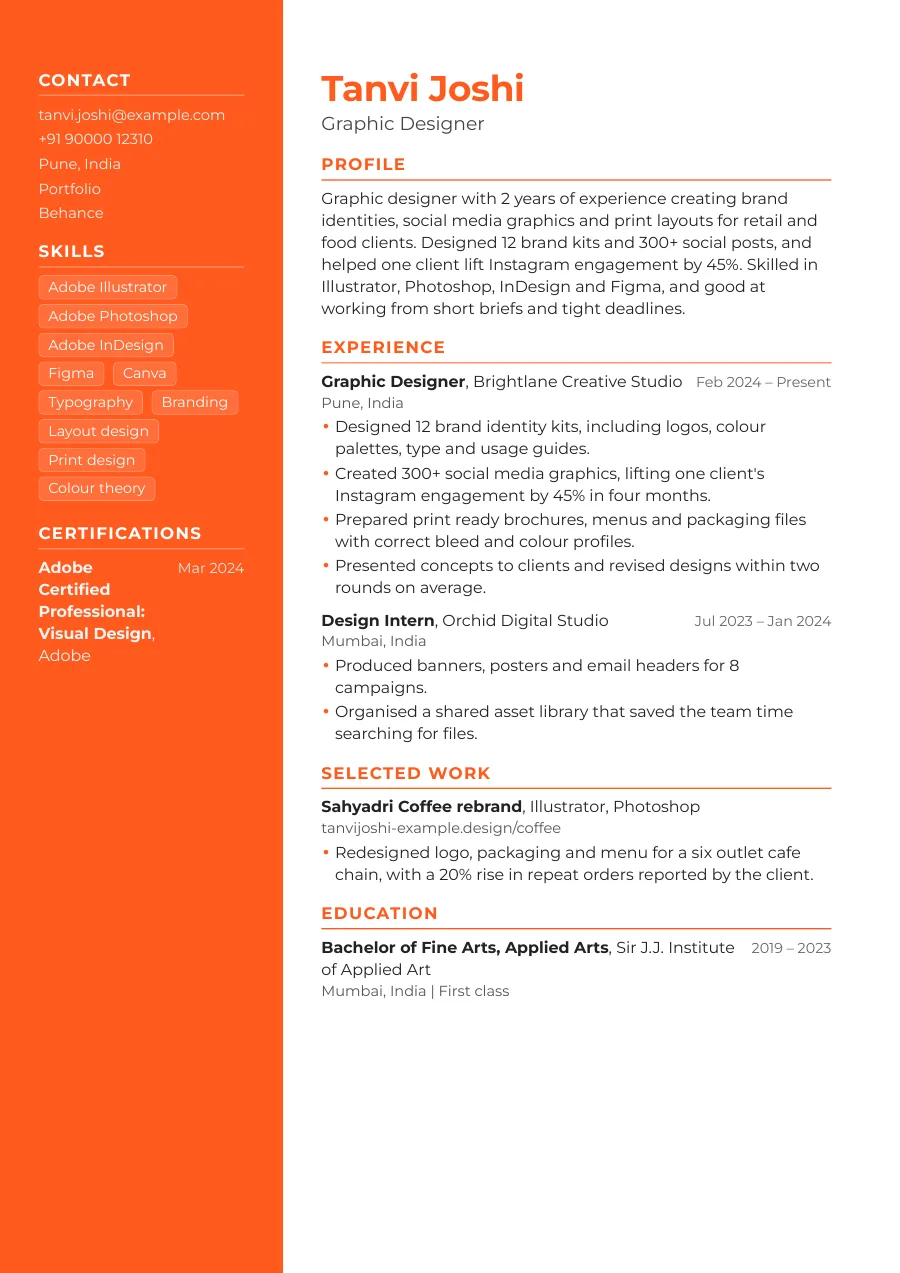
What recruiters look for in a graphic designer
For design jobs, the portfolio comes first and the resume supports it. Recruiters check that you have the right tools, that your work suits their industry, and that you can meet deadlines and work with feedback. Your resume should connect your design work to results such as engagement, sales or approvals.
Best section order
- Name, contact details and portfolio or Behance link
- Short profile of two or three lines
- Experience or internships
- Selected work, with one or two projects
- Skills
- Education and certifications
Freshers can put selected work and education first. The fresher resume format guide shows how to balance them.
How to write the summary
Say how many years you have worked, the type of design you do, your main tools and one result. For example: two years designing brand kits and social media for retail clients, lifted a client's Instagram engagement by 45%. Skip words like creative thinker. The summary generator can supply a draft.
Bullets that show value
| Weak | Strong |
|---|---|
| Designed logos and posters | Designed 12 brand identity kits for retail and food clients |
| Made social media posts | Created 300+ social graphics, lifting one client's engagement by 45% in four months |
| Prepared files for print | Delivered print ready files with correct bleed and CMYK profiles for menus, brochures and packaging |
Use counts, turnaround times and client outcomes. Where results belong to the client, phrase them carefully, such as reported by the client.
Skills and ATS keywords
Studios and agencies often use applicant tracking software, so include plain text keywords:
- Software: Adobe Illustrator, Photoshop, InDesign, After Effects basics, Figma, Canva, CorelDRAW
- Design: branding, logo design, typography, layout, colour theory, packaging, illustration
- Output: print design, prepress, social media graphics, presentation design, email design
- Working style: client communication, feedback, deadline management
Check your text against a posting using the ATS resume checker.
Certifications and education
A degree in fine arts, applied arts or design helps, but many designers are self-taught. Adobe Certified Professional is a recognised credential for software skills. Courses can fill gaps, but a portfolio of finished projects carries more weight.
Making the resume itself look designed
Your resume is a sample of your taste. Use a clear grid, two fonts at most, one accent colour and generous margins. Avoid image-based text, icons for contact details and skill bars, which ATS software cannot read. Export as PDF at a small file size, and check the links open on a phone.
Handling client work and permissions
Agencies share work under confidentiality, so ask before you publish anything. When a project cannot be shown, describe it in words on the resume: the brand type, the deliverables and the outcome. You can also create a case study with the client name removed. Keep the story honest, giving credit to art directors or teammates where they contributed.
India and abroad notes
- India: a photo is optional and not needed. Add your institute if it is well known in design.
- US, UK, Europe: leave out photo and personal details, include the portfolio link, and add work authorisation if the posting asks.
Common mistakes
- No portfolio link or a link to a folder that needs permission
- Skill ratings for Photoshop and Illustrator
- Long lists of tools with no projects to show
- Showing client work without permission
- Inconsistent fonts and spacing on the resume itself
Look through the resume templates and choose a layout that fits your style.
Skills for a Graphic Designer resume
Pick the ones that are true for you and that the job ad mentions. In the builder, Skills by job adds them with one tap.
- Adobe Illustrator
- Adobe Photoshop
- Adobe InDesign
- Figma
- Canva
- Logo design
- Branding
- Typography
- Layout design
- Colour theory
- Print design
- Packaging design
- Social media design
- Motion graphics basics
- Photo editing
- Illustration
- Prepress
- Creativity
- Time management
- Communication
- Attention to detail
- Receiving feedback
Graphic Designer resume bullet point examples
Use these as a starting point and change the numbers and details to your own. Anything in [brackets] is a placeholder for your real figure.
- Designed 12 brand identity kits with logos, colour palettes, typography and usage guidelines for small retail and food businesses.
- Created over 300 social media graphics, helping one client increase Instagram engagement by 45% in four months.
- Redesigned packaging for a snack brand, supporting a 20% increase in shelf pickup reported in the client's store tests.
- Prepared print ready files with correct bleed, CMYK profiles and fonts for brochures, menus and flyers.
- Delivered concepts from short briefs and finished revisions within two rounds for 90% of projects.
- Built a reusable template set in Canva that cut weekly post design time from six hours to two.
- Designed event banners, standees and invitation cards for five corporate events, delivered a day ahead of schedule.
- Retouched and colour corrected 500 product photographs for an online store using Photoshop and Lightroom.
- Maintained a shared asset library and naming system that helped the team find files quickly.
- Illustrated a set of [X icons] to match a client's brand style across their website and app.
- Presented design rationale to clients and incorporated feedback while keeping the identity consistent across [X touchpoints].
- Produced a [X page] annual report layout in InDesign with charts, images and consistent styles.
- Collaborated with copywriters and marketers on [X campaigns] to keep message and visuals aligned.
- Created simple animated social posts that increased average view time by [X%] compared to static images.
Resume summary examples for a Graphic Designer
Graphic designer with 2 years of experience in branding, social media and print. Strong with Illustrator and Photoshop, and careful about typography, spacing and consistent colour. Takes feedback well, meets deadlines, keeps files tidy for other designers, and presents ideas clearly so clients understand the thinking behind each design choice.
Fresher graphic designer with a Bachelor of Fine Arts in Applied Arts and a portfolio of ten projects, including logos, posters and packaging. Skilled in the Adobe suite and Figma, and eager to learn from senior designers in a busy creative studio, with a quick eye for detail and a positive response to feedback.
Designer moving from print production into brand design, with 4 years of experience preparing files for press. Now building a portfolio of identity and packaging work, and looking for a role that combines technical file knowledge with stronger creative ownership and the chance to work directly with clients on brand projects.
More resume examples
- Architect resume
- UI UX Designer resume
- Video Editor resume
- Accountant resume
- Internal Auditor resume
- Bank Officer resume
- Business Development Executive resume
- Chartered Accountant resume
- All resume examples by profession