What should a Physiotherapist resume include?
A physiotherapist resume should list your degree (BPT, MPT), council registration, clinical areas such as orthopaedic, neuro or sports, patients treated per day, techniques used, outcome measures and certifications like taping or dry needling. Show results in numbers. FixDoks gives you a timeline layout that makes each role and its results easy to follow.
Physiotherapist Resume at a glance
| Design | Timeline, ATS-friendly |
|---|---|
| Sample | PDF and Word download |
| Examples | 14 bullet points, 22 skills |
| Processing | On our server over HTTPS; files are deleted right after conversion |
| Max file size | 50 MB per file |
| Price | Free to use, no watermark |
| Download | First download free, then ₹49 for 2 months of unlimited downloads (US$3 outside India) |
| Files at once | 1 free, up to 30 with a plan |
| Works on | Chrome, Edge, Safari and Firefox on Windows, Mac, Android and iPhone |
How to use Physiotherapist Resume Template
- Click Use this template to open the builder with the Timeline design and a Physiotherapist section order, or Edit this example to start from the sample.
- Fill in your details. Use Examples and Skills by job for ready-made lines, or the AI writer for your own notes.
- Check the resume score, paste the job ad to see missing keywords, then download your PDF.
Physiotherapist resume sample
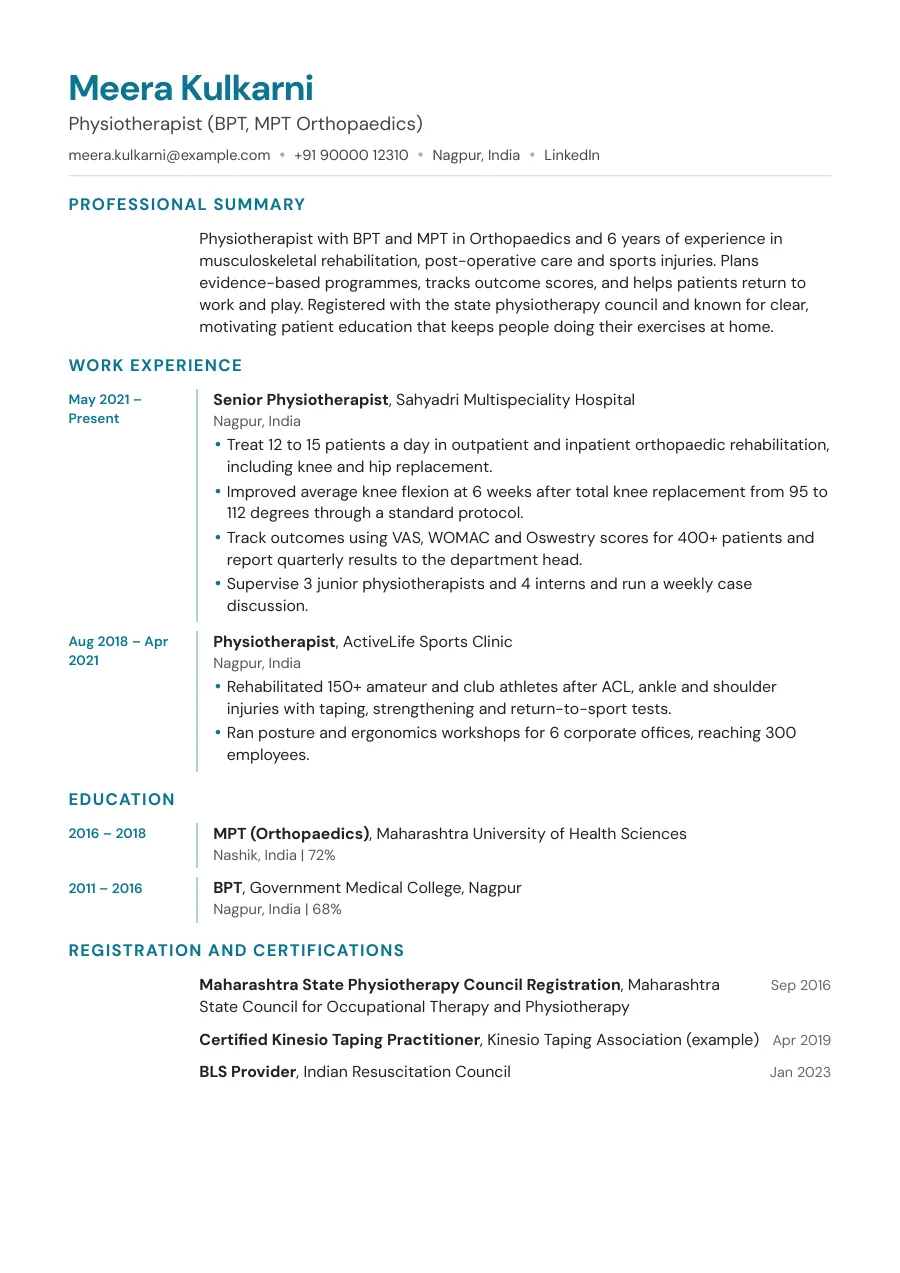
What recruiters look for in a physiotherapist resume
Hospitals, clinics and sports centres look for clinical scope and outcomes. They want to know your qualification, registration, speciality, patient volume and the techniques you use. They also look for evidence that patients got better: improved range, reduced pain, faster return to work or sport. Soft skills such as education and motivation matter as much as technique.
Best section order
Open with a short summary, then work experience in a timeline, education, registration and certifications and skills. Freshers should lead with education and internship rotations. Keep the resume to one page for up to five years of experience and two pages for senior therapists with teaching or research work.
How to write the summary
State your degrees, years of experience, main speciality, setting, and one outcome. Keep it to three or four lines. Try the resume summary generator for first drafts, then adjust it to your actual practice.
Strong bullet examples
| Weak | Strong |
|---|---|
| Treated knee patients | Improved average knee flexion at 6 weeks after total knee replacement from 95 to 112 degrees using a standard protocol |
| Gave exercises | Designed photo-guided home programmes and raised session attendance above 90% |
| Worked with athletes | Rehabilitated 150+ amateur athletes after ACL, ankle and shoulder injuries with return-to-sport tests |
The bullet point generator can help turn routine duties into outcomes.
Skills and keywords ATS filters for
- Musculoskeletal and post-operative rehabilitation
- Neurological, cardiorespiratory or paediatric physiotherapy
- Manual therapy, mobilisation, dry needling, taping
- Electrotherapy, ultrasound, exercise prescription
- Outcome measures: VAS, WOMAC, Oswestry, Berg balance
- Patient education, home programmes, documentation
Run your draft through the ATS resume checker to spot missing terms.
Registration and certifications
In India, list your BPT or MPT and your state physiotherapy council registration where applicable, with the year. Add courses you have completed, such as kinesio taping, dry needling, McKenzie or Mulligan concepts, and BLS. For work abroad, state your licensing exam status honestly, such as the HCPC route in the UK or the Gulf health authority exam.
India versus abroad
Indian clinics and hospitals often accept a photo and a line on languages known, which helps with patient communication. For the UK, Australia or Gulf, omit the photo and personal details and focus on registration status, clinical hours and evidence-based practice.
Show outcomes and patient education
Many therapists list techniques only. Employers also want to know that patients improved and returned to function. Include one line on outcome tracking and one on how you teach patients to manage at home. These two lines set your resume apart.
Add teaching and research when you have them
If you supervise interns, give seminars, publish a case report or present at a conference, add a short line. These show leadership and keep you in view for senior and academic roles. Keep it brief and factual, and name the event or journal so it can be checked.
Keep it readable
Clinicians skim. Use short bullets and clear dates.
Common mistakes
- Listing techniques without patient numbers or outcomes
- Hiding registration or exam status
- Writing only passive duty statements
- Mixing every course into one long list
- Using unclear job titles
Build your version with the AI resume builder.
Tailor to the setting
A hospital role wants post-operative and inpatient experience. A sports clinic wants return-to-sport testing and taping. A home care role wants independence, safety and family education. Choose the evidence that fits each job and place it first.
Skills for a Physiotherapist resume
Pick the ones that are true for you and that the job ad mentions. In the builder, Skills by job adds them with one tap.
- Musculoskeletal rehabilitation
- Post-operative rehabilitation
- Sports injury management
- Manual therapy
- Mobilisation
- Exercise prescription
- Electrotherapy
- Ultrasound therapy
- Kinesio taping
- Dry needling
- Gait training
- Neurological rehabilitation
- Outcome measures
- VAS and WOMAC
- Patient assessment
- Treatment planning
- Patient education
- Ergonomics
- Documentation
- Council registration
- Empathy
- Communication
Physiotherapist resume bullet point examples
Use these as a starting point and change the numbers and details to your own. Anything in [brackets] is a placeholder for your real figure.
- Treated 12 to 15 patients a day in outpatient and inpatient orthopaedic rehabilitation, including knee and hip replacement recovery.
- Improved average knee flexion at 6 weeks after total knee replacement from 95 to 112 degrees through a standard rehabilitation protocol.
- Tracked pain and function scores such as VAS, WOMAC and Oswestry for 400+ patients and reported quarterly results to the department head.
- Rehabilitated 150+ amateur athletes after ACL, ankle and shoulder injuries using strengthening, taping and return-to-sport testing.
- Supervised 3 junior physiotherapists and 4 interns and ran a weekly case discussion on assessment and treatment planning.
- Ran posture and ergonomics workshops for 6 corporate offices, reaching 300 employees and reducing back pain complaints.
- Designed home exercise programmes with photo guides for each patient and raised session attendance to above 90%.
- Reduced average treatment time for frozen shoulder cases by 2 weeks by combining mobilisation, stretching and strengthening.
- Assessed new patients in 30 minutes and documented findings, goals and plans in the electronic record on the same day.
- Delivered gait training and balance exercises to [X elderly patients] and reduced reported falls by [X%] in three months.
- Worked with orthopaedic surgeons and physicians to set rehabilitation goals for [X post-operative patients] each month.
- Used dry needling and manual therapy under protocol for [X patients] with chronic neck and low back pain.
- Organised free screening camps for [X residents] and referred patients with red flag symptoms to specialists.
- Taught [X sessions] to nursing staff on safe patient handling and early mobilisation after surgery.
Resume summary examples for a Physiotherapist
Physiotherapist with BPT and MPT in Orthopaedics and 6 years of experience in joint replacement rehabilitation, sports injuries and chronic pain. Tracks outcome scores, builds home programmes patients actually follow, and is registered with the state physiotherapy council. Comfortable with hospital and sports clinic settings alike.
Senior physiotherapist with 10 years in hospital and clinic settings. Leads a small team, designs protocols for post-operative recovery, and teaches interns. Strong at working with surgeons and patients to set realistic goals and measure progress. Calm with anxious patients and comfortable presenting results to doctors.
Recent BPT graduate with a six-month internship across orthopaedics, neurology and cardiorespiratory physiotherapy. Skilled in assessment, exercise prescription and electrotherapy, and looking for a junior physiotherapist role with mentorship and exposure to varied patients. Patient, observant and eager to build strong clinical habits from the start.
More resume examples
- Doctor (MBBS) resume
- Medical Lab Technician resume
- Staff Nurse resume
- Pharmacist resume
- Accountant resume
- Architect resume
- Internal Auditor resume
- Bank Officer resume
- All resume examples by profession